About “Planet 42 Alpha”

I set out to write how a character changes over 74 sequential stories. The main character, Resada Gestae, is not always the narrator, but the entire arc of 74 stories is Resada Gestae’s story over a number of years. I thought there would be exactly 74 stories, one for each planet my narrator visits, but in writing the stories there were some surprises: the 42nd stop included two worlds, an asteroid belt, and a break in the journey – two stories set in the same solar system.

These two stories will appear in 4 Star Stories: “Planet 42 Alpha” and “Planet 42 Beta”. The first story, “Planet 42 Alpha” is out now. It starts as a typical stop on Lt Gestae’s mission of reconstructive justice. (None of these visits turn out as base staff may have envisioned them.) If this sounds familiar, the 38th stop also appeared in 4 Star Stories: “Planet 38” in 4 Star Stories (Summer 2013).

Five stories in this arc of 74 are now out and I am tremendously pleased to have two appearing in 4 Star Stories. To follow Lt Gestae across this larger story, read: 1) “No Woman, No Plaything” in Kaleidotrope (October 2012), 2) “Planet 38” in 4 Star Stories (Summer 2013), 3) “Planet 42 Alpha” in 4 Star Stories, 4) “Planet 42 Beta” in 4 Star Stories (forthcoming), and 5) “Crush” in Tree and Stone’s “Queer as F” themed issue (December 2023). This last story may be a bit disorienting: we see Lt Gestae from the outside and not as a narrator.

This is a trait of my work: the minor characters in one work may be the narrators in another. To follow the broader story of Ke, Resada’s spouse who narrates “Crush”, read: 1) This is Not a Love Story in Black Denim Lit (October 2015) (two partners meet), 2) “Inducement” in Black Denim Lit (September 2016) (two partners solve a case), 3) “Searching” in Black Denim Lit #8 (December 2014) (two partners get a new case, that of one Resada Gestae), 4) “Planet 42 Beta” in 4 Star Stories (September 2024) (trying to keep tabs on Lt Gestae), 5) “Planet 50” in Black Denim Lit (July 2015) (stuck on one ship with Lt Gestae), and finally 6) “Crush” in Tree and Stone’s “Queer as F” themed issue (December 2023) (married – to of all people, Resada Gestae), (and in 7) my play “The Other Two Men”) (cloned in the far future – to solve a problem in “Crush”).

To follow the wider story of Resada’s first husband Rain (who, despite his importance, never narrates any of these stories), read: 1) “Grave’s First Day” in A Coup of Owls (August 2021) (becomes an unmarried father), 2) “Searching” in Black Denim Lit #8 (December 2014) (brings future spouses in on an ongoing case that will change all their futures), 3) “Planet 42 Beta” in 4 Star Stories (September 2024) (a brief chance to be married), then 4) “Crush” in Tree and Stone’s “Queer as F” themed issue (December 2023) (married for good).

Since all of these works are part of a network of related stories, to understand why Resada Gestae is making these visits start with: “Searching” in Black Denim Lit #8 (December 2014). To read about previous stops read “No Woman, No Plaything” in Kaleidotrope (October 2012) or “Planet 38” in 4 Star Stories (Summer 2013). The people Resada speak to in the opening paragraphs of “Planet 42 Alpha” are introduced in “Life on Earth” in Expanded Horizons (January 2015) and appear in other works that are not yet out. To take a jump into the future read “Crush” in Tree and Stone’s “Queer as F” themed issue (December 2023).

To see the entire arc of stories laid out in chronological order (and, in fact, all the stories happening during a thousand-year effort to colonize the galaxy) see “Read my Short Stories in Order”.

  • Lisa Shapter

Five Below’s “8 Count Fountain Pens” Review

For however long it lasts, Five Below currently stocks an “8 Count Fountain Pen” set of $5 (US) rainbow-colored “Made in China” fountain pens that look a lot like the set of rainbow Ooly fountain pens at bookstores and art supply stores. They are not exactly like the Ooly pens: the design of the pen and nib is slightly different and the pen body colors and ink colors are slightly different. The cartridges are narrower (less ink!) than Ooly proprietary cartridges and the 2 cartridges do not swap (i.e. to get more cartridges for your Ooly pens buy them from Ooly.)

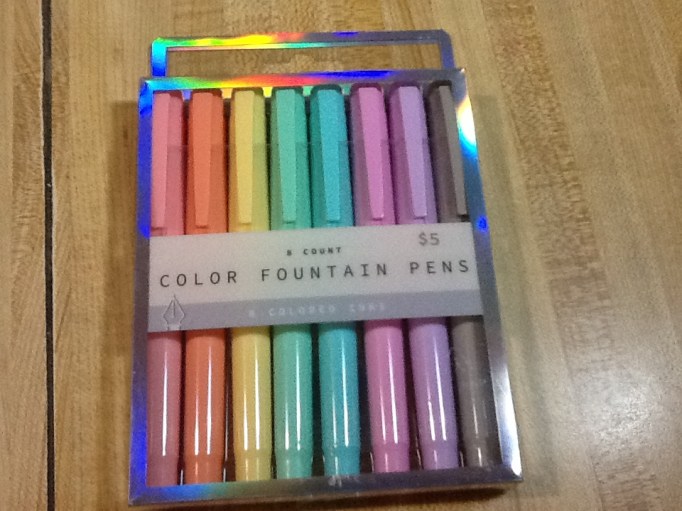
The 8 Count Color Fountain Pens/8 Colored Inks in their package. (The inks are inside the pens.)

Of my set of 8 pens Five Below most wrote after the usual steps with any new fountain pen: wipe the tip of the nib with rubbing alcohol (or hand sanitizer) to remove any protective wax or grease, give the feed a brief bath in warm water with a drop of dish soap or Castile soap, blow through the feed (as if blowing up a balloon) to remove any dust or microscopic plastic shavings, then rise the nib in warm water and shake it dry. Insert the cartridge (directions are on the back of the package: I had to press hard on a firm surface and then remove the cartridge and dip the point of the nib into the cartridge to be sure the plastic seal was really broken – then put the cartridge back in.) One pen out of the 8 was a slow starter so I pressed gently back on the metal nib and dipped it in water: after that it worked as well as the rest.

Briefly cleaning the feed and nib is a helpful step with any new fountain pen.

These pens all came with a little piece of white paperboard to cushion the cartridges inside the pens during shipping. It’s not a part of the pen and can be recycled but it’s an odd touch and a sign of how small these cartridges are. (The back of the package notes that the ink cartridge diameter is “2.6mm”. That would be great if I had any idea of the diameter of a standard pen feed ….) I did get a standard international cartridge (a generic fountain pen ink cartridge) to fit on one of the pens and it wrote without leaking: so once the cartridges that came with the pens run out they can write with ordinary cartridges and there are several brands in rainbows of colors to choose from.

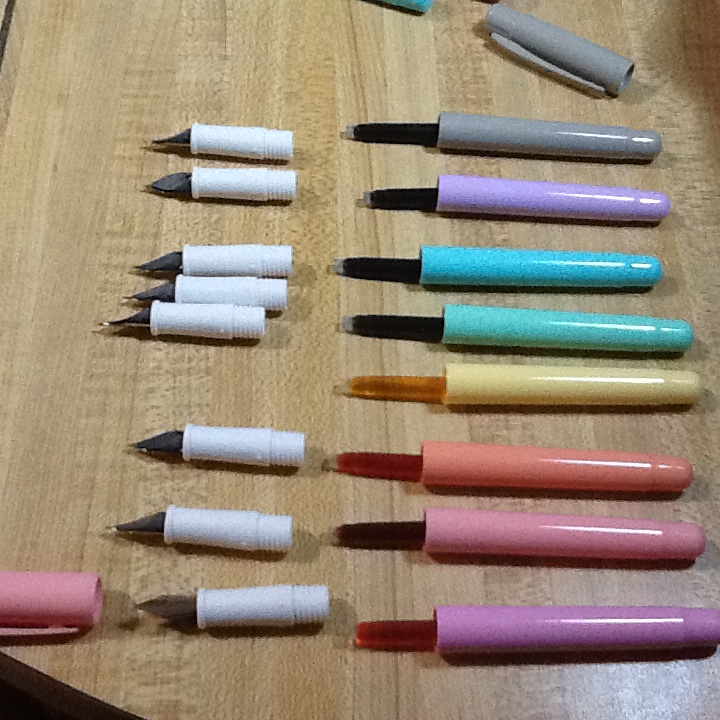
The pens with their matching inks.

These are also not eyedropper pens: unless you can make the full 16th of an inch hole in the back of the pen watertight there will be no filling the whole body of the pen with bottled ink.

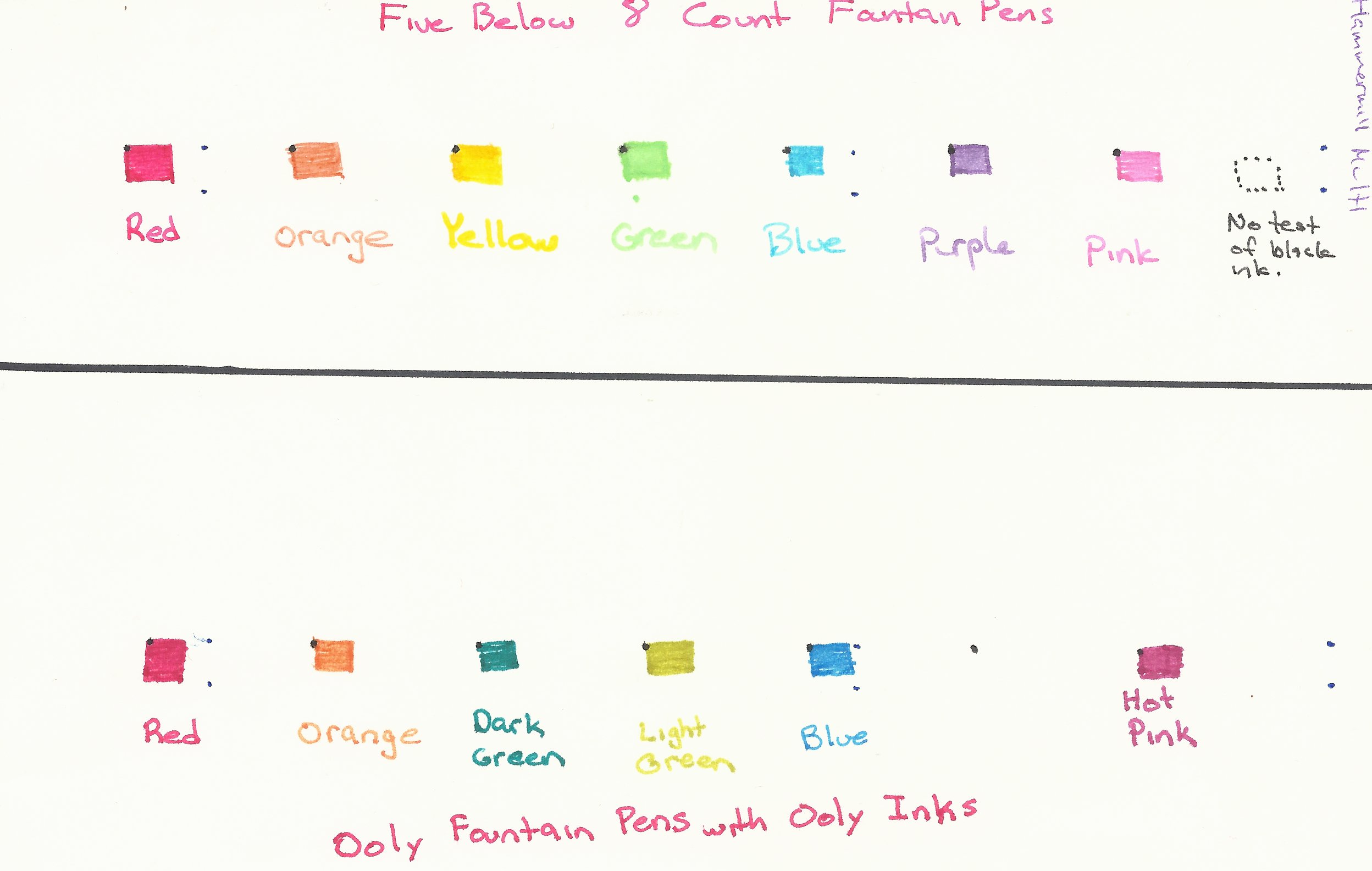
The 8 Count Fountain Pen inks vs. the Ooly fountain pen inks on Hammermill Multi printer paper.

These pens write well enough, have a slight flex in their nibs, take standard cartridges, and are an inexpensive pen for matching the color of your pen to the color of ink, inside (or for trying out no-name inks that might clog a prized, more expensive pen). They are as good as most low-end pens with stamped steel nibs (inexpensive or disposable Pilots, Itoyas, Zebras, Oolys, etc.) and I haven’t yet gotten them to leak. (They do write better if kept point down: better pens should be kept nib up.)

Top: The 8 Count fountain pen Bottom: An Ooly fountain pen

-Lisa Shapter

Note: I have no connection with Five Below, I bought these pens on my own at full price, and I owe a thanks to YouTuber SuperRaeDizzle for mentioning that Five Below has a website.

Five Below’s “2 Count Calligraphy Fountain Pen” Review

I like fountain pens for their longevity (I have 100 year old pens), how they write, how comfortable they are to write with (if you are willing to try out different weights and widths of pens), and the variety of ink colors. Expensive pens write well and have the durability and workmanship to last 100 years but (since it’s a good time to carry your own pen) I try not to own anything I’d fear losing while running errands.

My few (not very) expensive pens stay home for letters and long form writing but I am always on the lookout for inexpensive pens to treat more cavalierly. I especially like finding fountain pens at drug stores, office supply stores, and discount stores. For this hot minute Five Below sells two types of fountain pens: the “2 Count Calligraphy Fountain Pen” ($3.25 US) and the “8 Count Fountain Pen” ($5 US). This is a review of the first (a “Made in China” knock off of the excellent and more expensive Lamy pens found in bookstores and stationary stores).

The 2 Count Calligraphy Fountain Pens in their package

The package comes with two pens (one with a Fine nib, the other with an Extra Fine nib) and four generic black ink cartridges. There are directions on the back but you will need to push firmly if you are using your own ink cartridges, instead. (The package helpfully(?) notes the ink feed’s diameter is 3.4 mm. I have no idea how this compares with other, standard pens.)

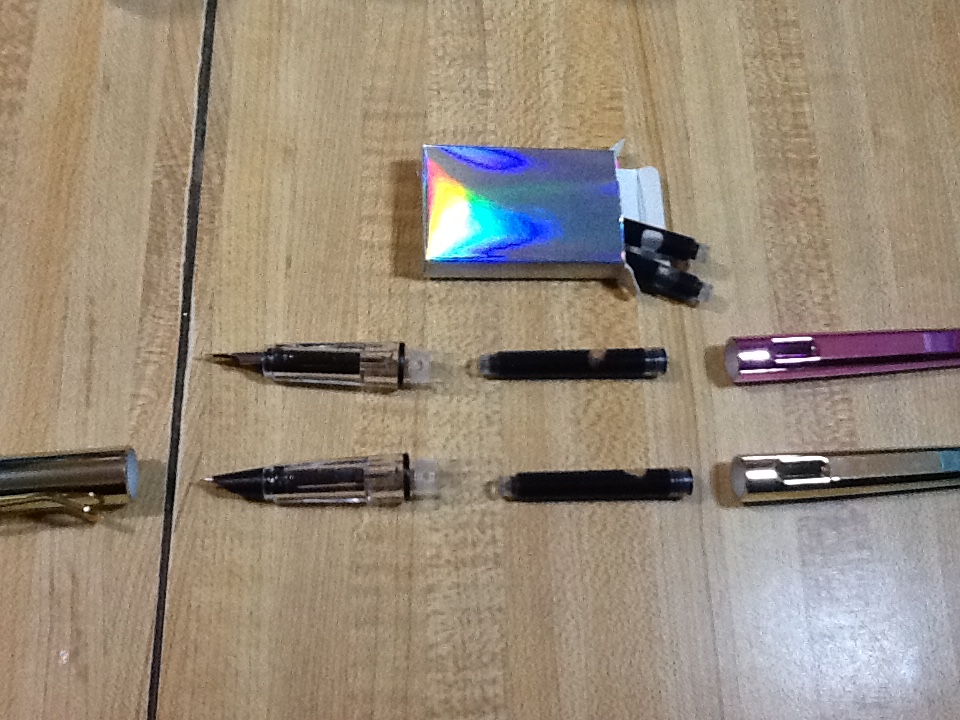
The 2 Count Calligraphy Fountain pens ready to be put together, with the box of spare ink cartridges.

The “2 Count Calligraphy” pens are not calligraphy pens. They have ordinary fountain pen nibs that write “Fine” (hooded nib) and “Extra Fine” (standard nib) – not the wide square tips for fancy lettering.

The nibs and feeds of the pens (which kept rolling when I tried to get a top view).

They will write with a line like a ballpoint’s: for actual calligraphy fountain pens there are several good choices at most crafting stores. These pens do have an advantage: most high end fountain pens do not come with “Extra Fine” nibs (“Medium” is far more common – think of a thick-lined 1 mm gel pen) but the tradeoff is that fountain pen fans are always looking for paper that won’t feather the ink like a cheap felt-tip pen or have it show through badly on the other side of the page. If you want a fountain pen that will write well on nearly any paper (ordinary notebook paper, printer paper, most cards and stationary) an “Extra Fine” pen is your best bet. There are two flat places on these pens for your fingers so you know you’re holding the pen correctly. (Write with a fountain pen at a low angle to the paper: for best results write with the blob on the side of the nib not with the very tip of the sharp point.)

These Five Below pens write beautifully. They have ink windows that let you see when you’re running low on ink. These are not eyedropper pens: blowing into them shows air leaks around the ink window. Unless you could seal the window without covering it over there will be no filling the whole back of the pen with bottled ink. (I recommend using up the ink they came with then filling the empty plastic cartridge from your choice of bottled ink with a dull syringe: an online pen store of your choice can set you up with both.)

How the 2 pens write (top: the black ink they came with bottom: a standard international cartridge of Thornton’s green).

These pens take standard international ink cartridges (ye generic standard ink cartridges) but I had to press hard on a firm surface to get the narrow end of the cartridge to seat correctly. (It took a few tries to get the cartridge flush to the back of the feed so the pen could not leak.)

Top: one of the black cartridges that came with the pens Bottom: a standard international cartridge of Thornton’s black for comparison.

I was prepared to write a you-get-what-you-pay for review about the usual faults of cheap pens (‘won’t write, write only in ink blots, won’t take any kind of cartridge you can ever find again, leaks’) but I recommend these pens: they are good starter pens that write surprisingly well and pleasantly, do not feather or bleed on most ordinary types of paper (sticky notes, free charity notepads, printer paper, school notebooks, inexpensive Thinking of You cards), and so far they write without blobbing or leaking. They are a good choice if you want to try out fountain pens or want a pen for that off-brand glitter-filled or corrosive vintage ink that might clog (or eat) a pricier pen.

-Lisa Shapter

Note: I have no connection with Five Below, I bought these pens on my own initiative at full price, and I owe a thanks to YouTuber SuperRaeDizzle (check out both channels, esp. the tests of historic art supplies and vanished paint colors!) for mentioning that Five Below has a website.

My Routine

I seem to alternate years of not finding a publisher with years of better luck.  My routine is the same with either:  write a short story a week (I’ve nearly finished a sequence of 36 stories taking place on successive days); send rejected stories out to another publisher; query agents for a novel; and revise a 3/4 done novel, novella (usually a past year’s National Novel Writing Month project), or first draft of a short story  or script — all of which must be kept in continuity with each other.


I used to think when a favorite writer didn’t have anything new that they were either writing a novel or taking time off.  Most writers I know work steadily, all the time, and there’s a portion of luck in appears in print/on screens and when.  A writer is someone who writes: I keep at it (and all the secretarial work that goes with finding publication) until my luck changes.


-Lisa Shapter


For Your Bradbury Award Consideration

The production script for  my first play, “The Other Two Men,” is on the Bradbury Award Suggested Reading List for Outstanding Dramatic Presentation:

http://www.sfwa.org/forum/?app=readinglist&year=2016&category=bradbury

Science Fiction and Fantasy Writers of America members may read the script here:
http://www.sfwa.org/forum/index.php?/topic/10880-the-other-two-men-by-lisa-shapter/

The script is set 800 years in the future in a colonized Milky Way galaxy. In this play, historians on an established colony world decide to clone two of their four planetary founders in order to solve the problem of what went wrong in their lives. These clones are raised in strict historical recreations of their 300-years-gone-by North America hometowns and are given the same military training as their originals.

This play is about the day the two young men meet.

They find themselves locked in one room until they solve an unspecified problem about the past. Some things go wrong:  historians on this colony planet have only cloned two of the four founding figures; the clones have figured out they are duplicates of famous long-dead men and everyone around them is an actor in a living history museum; and they’re two unique new people – not their original, heroic progenitors.

It is is a story about free will and predestination – what can and cannot be planned. It is about a relationship that do not fit conventional categories and a story that does not follow conventional patterns.

-Lisa Shapter

_________________________________________________________________

Deep background (Or:  (Nearly) Everything I Write is in the Same Universe) —

This script is based on an unpublished short story.   The play stands on its own, but it  is linked to an ongoing series of short stories now appearing in Black Denim Lit.  The prequel stories are:

This is Not a Love Story in Black Denim Lit (October 2015)  (How the originals of the two clones met.)

Inducement” in Black Denim Lit (2016)

Searching” in Black Denim Lit #8 (December 2014) (The Rain and the Resada mentioned in passing in the script)

Planet 50” in Black Denim Lit (July 2015) (A better view of Resada.)


These related stories are set in the same universe:

The World in His Throat in Things We Are Not: An M-Brane SF Magazine Queer Science Fiction Anthology (2009)

Life on Earth” in Expanded Horizons (January 2015)

Nightskyman Hope” in Expanded Horizons (January 2016)

No Woman, No Plaything” in Kaleidotrope (October 2012)  (Resada on her own.)

Planet 38” in Four Star Stories (Summer 2013)  (Another story about Resada on her own.)


I also have an unrelated alternate history novella published by Aqueduct Press:

A Day in Deep Freeze


Nearly all of my work is interconnected:  each work stands on its own but each piece adds depth and nuance to the others.  Those who read this script will know things about these characters that no one else knows.  (Readers of the short stories will appreciate the two original characters’ world and why their descendants might have wanted to clone them.  There was a draft of the script where the two originals and Rain and Resada had an entire conversation about the world they’d founded (and their worries for the place) but it didn’t end up in the production.)


The script also benefited immensely from the feedback and questions from the workshop reading by Generic Theater, and the specific and detailed revision suggestions of Susan Turner, Alan Huisman, Alex Pease, Collin Snider; and the careful rehearsal process at The Players’ Ring — with the sound advice of Tomer Oz, Emery Lawrence, Bailey Weakley, and the encouragement and wisdom of Todd Hunter, Barbara Lakin Newton, and master playwrights David J. Mauriello and Jim Kelly.  I was tremendously moved by the play’s reception and have made friends of fellow artists that I hold dear.

-Lisa Shapter