Five Below’s “2 Count Calligraphy Fountain Pen” Review

I like fountain pens for their longevity (I have 100 year old pens), how they write, how comfortable they are to write with (if you are willing to try out different weights and widths of pens), and the variety of ink colors. Expensive pens write well and have the durability and workmanship to last 100 years but (since it’s a good time to carry your own pen) I try not to own anything I’d fear losing while running errands.

My few (not very) expensive pens stay home for letters and long form writing but I am always on the lookout for inexpensive pens to treat more cavalierly. I especially like finding fountain pens at drug stores, office supply stores, and discount stores. For this hot minute Five Below sells two types of fountain pens: the “2 Count Calligraphy Fountain Pen” ($3.25 US) and the “8 Count Fountain Pen” ($5 US). This is a review of the first (a “Made in China” knock off of the excellent and more expensive Lamy pens found in bookstores and stationary stores).

The 2 Count Calligraphy Fountain Pens in their package

The package comes with two pens (one with a Fine nib, the other with an Extra Fine nib) and four generic black ink cartridges. There are directions on the back but you will need to push firmly if you are using your own ink cartridges, instead. (The package helpfully(?) notes the ink feed’s diameter is 3.4 mm. I have no idea how this compares with other, standard pens.)
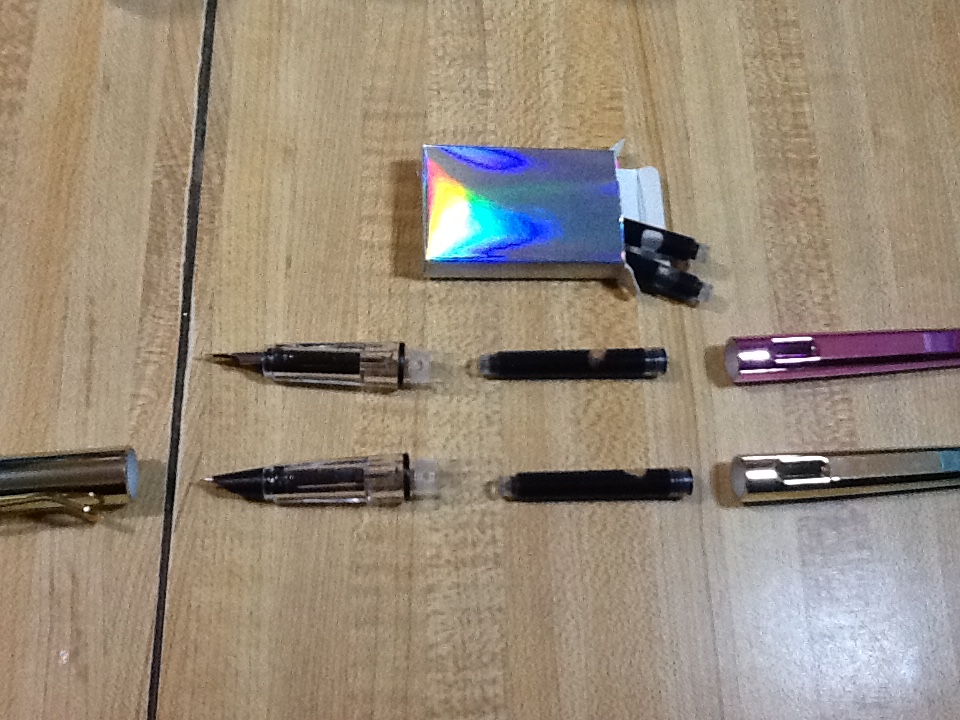
The 2 Count Calligraphy Fountain pens ready to be put together, with the box of spare ink cartridges.

The “2 Count Calligraphy” pens are not calligraphy pens. They have ordinary fountain pen nibs that write “Fine” (hooded nib) and “Extra Fine” (standard nib) – not the wide square tips for fancy lettering.

The nibs and feeds of the pens (which kept rolling when I tried to get a top view).

They will write with a line like a ballpoint’s: for actual calligraphy fountain pens there are several good choices at most crafting stores. These pens do have an advantage: most high end fountain pens do not come with “Extra Fine” nibs (“Medium” is far more common – think of a thick-lined 1 mm gel pen) but the tradeoff is that fountain pen fans are always looking for paper that won’t feather the ink like a cheap felt-tip pen or have it show through badly on the other side of the page. If you want a fountain pen that will write well on nearly any paper (ordinary notebook paper, printer paper, most cards and stationary) an “Extra Fine” pen is your best bet. There are two flat places on these pens for your fingers so you know you’re holding the pen correctly. (Write with a fountain pen at a low angle to the paper: for best results write with the blob on the side of the nib not with the very tip of the sharp point.)

These Five Below pens write beautifully. They have ink windows that let you see when you’re running low on ink. These are not eyedropper pens: blowing into them shows air leaks around the ink window. Unless you could seal the window without covering it over there will be no filling the whole back of the pen with bottled ink. (I recommend using up the ink they came with then filling the empty plastic cartridge from your choice of bottled ink with a dull syringe: an online pen store of your choice can set you up with both.)

How the 2 pens write (top: the black ink they came with bottom: a standard international cartridge of Thornton’s green).

These pens take standard international ink cartridges (ye generic standard ink cartridges) but I had to press hard on a firm surface to get the narrow end of the cartridge to seat correctly. (It took a few tries to get the cartridge flush to the back of the feed so the pen could not leak.)

Top: one of the black cartridges that came with the pens Bottom: a standard international cartridge of Thornton’s black for comparison.

I was prepared to write a you-get-what-you-pay for review about the usual faults of cheap pens (‘won’t write, write only in ink blots, won’t take any kind of cartridge you can ever find again, leaks’) but I recommend these pens: they are good starter pens that write surprisingly well and pleasantly, do not feather or bleed on most ordinary types of paper (sticky notes, free charity notepads, printer paper, school notebooks, inexpensive Thinking of You cards), and so far they write without blobbing or leaking. They are a good choice if you want to try out fountain pens or want a pen for that off-brand glitter-filled or corrosive vintage ink that might clog (or eat) a pricier pen.

-Lisa Shapter

Note: I have no connection with Five Below, I bought these pens on my own initiative at full price, and I owe a thanks to YouTuber SuperRaeDizzle (check out both channels, esp. the tests of historic art supplies and vanished paint colors!) for mentioning that Five Below has a website.

My Routine

I seem to alternate years of not finding a publisher with years of better luck.  My routine is the same with either:  write a short story a week (I’ve nearly finished a sequence of 36 stories taking place on successive days); send rejected stories out to another publisher; query agents for a novel; and revise a 3/4 done novel, novella (usually a past year’s National Novel Writing Month project), or first draft of a short story  or script — all of which must be kept in continuity with each other.


I used to think when a favorite writer didn’t have anything new that they were either writing a novel or taking time off.  Most writers I know work steadily, all the time, and there’s a portion of luck in appears in print/on screens and when.  A writer is someone who writes: I keep at it (and all the secretarial work that goes with finding publication) until my luck changes.


-Lisa Shapter


For Your Bradbury Award Consideration

The production script for  my first play, “The Other Two Men,” is on the Bradbury Award Suggested Reading List for Outstanding Dramatic Presentation:

http://www.sfwa.org/forum/?app=readinglist&year=2016&category=bradbury

Science Fiction and Fantasy Writers of America members may read the script here:
http://www.sfwa.org/forum/index.php?/topic/10880-the-other-two-men-by-lisa-shapter/

The script is set 800 years in the future in a colonized Milky Way galaxy. In this play, historians on an established colony world decide to clone two of their four planetary founders in order to solve the problem of what went wrong in their lives. These clones are raised in strict historical recreations of their 300-years-gone-by North America hometowns and are given the same military training as their originals.

This play is about the day the two young men meet.

They find themselves locked in one room until they solve an unspecified problem about the past. Some things go wrong:  historians on this colony planet have only cloned two of the four founding figures; the clones have figured out they are duplicates of famous long-dead men and everyone around them is an actor in a living history museum; and they’re two unique new people – not their original, heroic progenitors.

It is is a story about free will and predestination – what can and cannot be planned. It is about a relationship that do not fit conventional categories and a story that does not follow conventional patterns.

-Lisa Shapter

_________________________________________________________________

Deep background (Or:  (Nearly) Everything I Write is in the Same Universe) —

This script is based on an unpublished short story.   The play stands on its own, but it  is linked to an ongoing series of short stories now appearing in Black Denim Lit.  The prequel stories are:

This is Not a Love Story in Black Denim Lit (October 2015)  (How the originals of the two clones met.)

Inducement” in Black Denim Lit (2016)

Searching” in Black Denim Lit #8 (December 2014) (The Rain and the Resada mentioned in passing in the script)

Planet 50” in Black Denim Lit (July 2015) (A better view of Resada.)


These related stories are set in the same universe:

The World in His Throat in Things We Are Not: An M-Brane SF Magazine Queer Science Fiction Anthology (2009)

Life on Earth” in Expanded Horizons (January 2015)

Nightskyman Hope” in Expanded Horizons (January 2016)

No Woman, No Plaything” in Kaleidotrope (October 2012)  (Resada on her own.)

Planet 38” in Four Star Stories (Summer 2013)  (Another story about Resada on her own.)


I also have an unrelated alternate history novella published by Aqueduct Press:

A Day in Deep Freeze


Nearly all of my work is interconnected:  each work stands on its own but each piece adds depth and nuance to the others.  Those who read this script will know things about these characters that no one else knows.  (Readers of the short stories will appreciate the two original characters’ world and why their descendants might have wanted to clone them.  There was a draft of the script where the two originals and Rain and Resada had an entire conversation about the world they’d founded (and their worries for the place) but it didn’t end up in the production.)


The script also benefited immensely from the feedback and questions from the workshop reading by Generic Theater, and the specific and detailed revision suggestions of Susan Turner, Alan Huisman, Alex Pease, Collin Snider; and the careful rehearsal process at The Players’ Ring — with the sound advice of Tomer Oz, Emery Lawrence, Bailey Weakley, and the encouragement and wisdom of Todd Hunter, Barbara Lakin Newton, and master playwrights David J. Mauriello and Jim Kelly.  I was tremendously moved by the play’s reception and have made friends of fellow artists that I hold dear.

-Lisa Shapter

The Other Two Men: Credits & Acknowledgements

At the end of the workshop reading and Q&A  of my play last November, Alex Pease spoke to me about getting the script ready for production.   One of the first things he said was:  “Theater is collaborative.”


To honor that truth, let me say that I owe every success of the first production of my science fiction play “The Other Two Men” (review) to the professional acumen and hard work of many, many partners, advisers, and benefactors —


Lisa Shapter wishes to thank Christopher T. Garry and Back Denim Lit, the first venue to take a risk on these characters.  She also wishes to thank everyone who came out to see the reading or the production of a new work of science fiction as experimental live theater.  She also extends her profound gratitude to every actor who auditioned for an unknown role in a new play set in the far future.  She also thanks James Patrick Kelly for his generosity of soul and his commitment to science fiction in New England; Alex Pease (and Outcast Productions) for his guidance and encouragement, Tomer Oz (and Oz Productions) for his kindness and dedication; playwright David Mauriello for his solicitude and wise advice; Tomer Oz for his audio narration and concept art and Kaitlyn Huwe for poster art; Jasmin Hunter (and Jasmin Hunter Photography) for publicity photos; Joi Smith (Back Alley Productions) for publicity; Sam Smith, Alex Pease, Bretton Reis (lighting design), Mike Kimball (sound design), and Tomer Oz for giving their all on lighting and sound; Barbara Newton for holding the whole place together; and the Generic Theatre and the Players’ Ring for taking a risk on this (and other) new work in the Reading Series and Late Night Series.  She also wishes to thank the Generic Theatre‘s Susan Turner and Collin Snider.  She particularly wishes to thank the play’s two leads Bailey Weakley and Emery Lawrence, whose gifts and skills kept turning up things about these characters and their relationship that (the author was certain) only appeared in as-yet unpublished short stories.  (These talents are all the more evident when they are working with material by experienced script writers.)  It has been a pleasure and an honor to work with all of you.


Oz Productions wishes to thank PPMTV for their rehearsal space, Lisa, Emery, Bailey, Sam, Alex, Brett, Mike, Tin, Jaz, Todd, Joi, Peter, Barb and everybody else at The Players’ Ring, Generic Theater and everybody who was part of the reading, everybody who auditioned, and anybody else who was involved in making this production what it is today!  Also, thanks to you, the audience for coming to see the show!


The Players’ Ring wishes to thank all of its members (become one today!), volunteers, and LCHIP donors!  It also wishes to thank its 24th season sponsors:  the Atlantic Grill, Allegra Marketing, the EDGE, Heinemann Publishing,  and the Sound.  It also wishes to thank its generous supporters at Pickwick Mercantile, Garrison Players, Federal Savings Bank, Geno’s Chowder and Sandwich Shop, Ambrosia Gardens Florist, Piscataqua Savings Bank, Orange Leaf Frozen Yogurt, Ceres St. Bakery, The Salt Cellar, Generic Theater’s production of Love, Loss and What I Wore by Nora and Delia Ephron, Cavarretta Gardens, The Seacoast Repertory Theater (The Rep), the New Hampshire Division of Historical Resources for its grant via its Conservation License Plate Grant Program (the ones with the moose!), Hazel Boutique, the Library Restaurant, Kennedy Gallery and Framing, Old Ferry Landing Restaurant, Discover Portsmouth, Tugboat Alley, Puttin’ in the Glitz, Great Bay Spa & Sauna, Portsmouth Book & Bar, Louis Clarizio DDS PA, Esta Resale Clothing, Sanders Fish Market, The Press Room, New Hampshire Professional Theater Association, Music on Wheels & DJ Mile Pomp, and The District Restaurant, and the Portsmouth Gas Light Restaurant.


Support the arts by supporting these local businesses!   Lisa Shapter also wishes to acknowledge the following friends of the arts:


210 Hair Salon, B.G.’s Boathouse, Bubby’s Deli, the Greater Portsmouth Chamber of Commerce, Philbrick’s Fresh Market, Fresh Press Juice, Warner’s Hallmark Store on Market Square, Hannaford’s Supermarket, the Ice House Restaurant, Jardiniere Flowers, the ever-helpful Information Kiosk in Market Square, Justin’s Seafood Hut (Hebert Brothers), Kittery Trading Post, the Life is Good Clothing Store on Market Square, Lexie’s Joint Burgers, Dr. Mark Moses, Pink Bamboo Hotpot Cafe Restaurant, Portsmouth Public Library, River Run Bookstore (they carry my work), Robert’s Maine Grill Restaurant, Seaport Fish, Sheafe Street Books, Spectrum by Design Hair Salon, Water Street Bookstore (they carry my work).


Credits:

Theater Programs and Posters:  Southport Printing Company

Ms. Shapter’s Florist:  Jardiniere Flowers

Ms. Shapter’s Makeup Provided by CHANEL

Makeup Artist:  Camille at CHANEL (Macy’s) (Ask for her at the CHANEL counter!)

Ms. Shapter’s Hair by 210 Hair Salon

Hair Stylist:  Melissa at 210 (Ask for her!)